
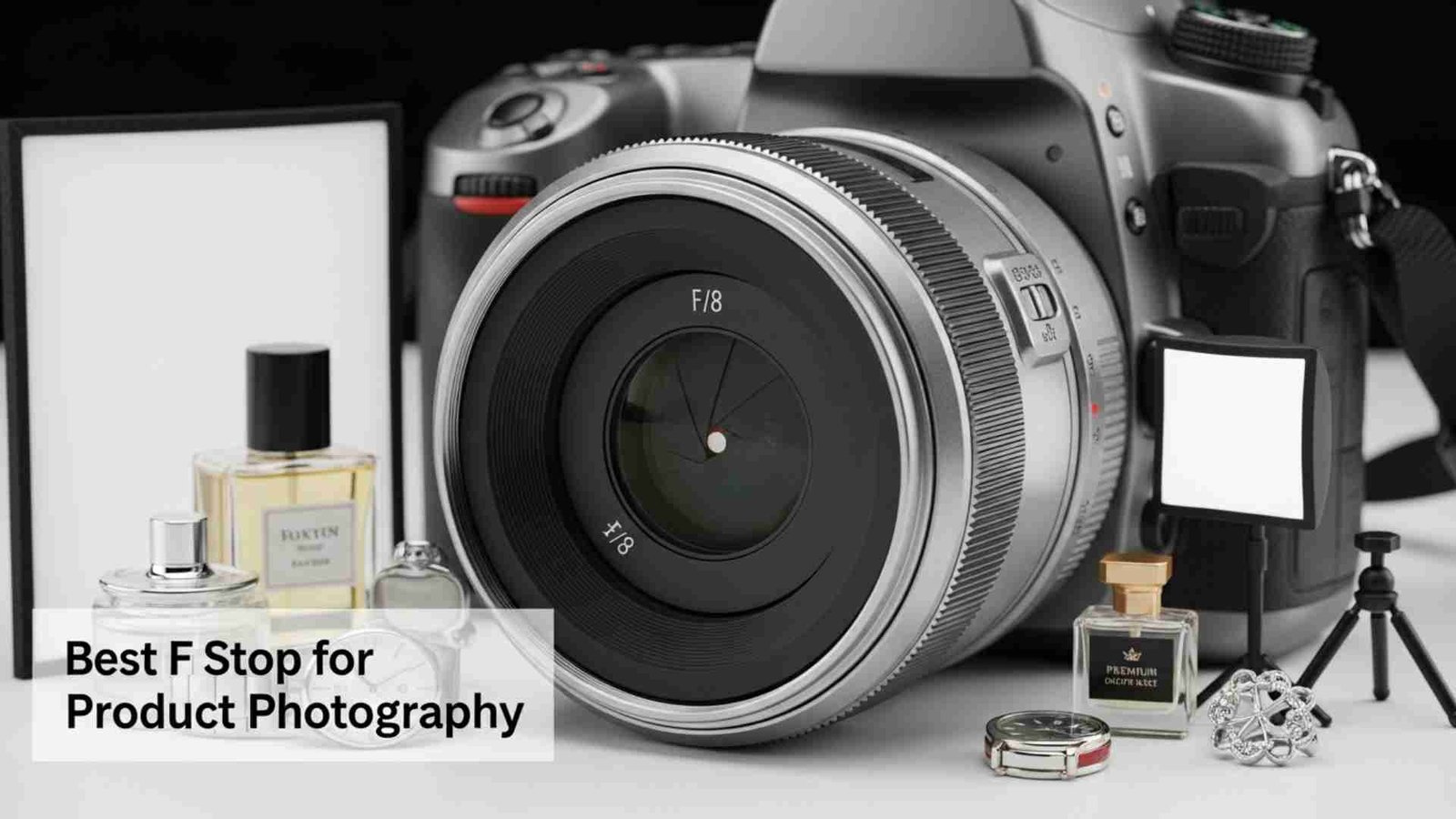
When you’re trying to create clean, sharp, and professional-looking product photos, the one camera setting that can instantly make or break the entire shot is your f-stop. If you’ve ever wondered why some product photos look crisp from edge to edge while others appear soft or out of focus, the answer almost always comes down to choosing the Best F Stop for Product Photography. And because this topic is so essential for eCommerce sellers, brands, and photographers, we’re going to explore it in the simplest, friendliest, and most practical way possible.
Whether you shoot with a DSLR, mirrorless camera, macro lens, or standard zoom lens, your aperture setting directly affects depth of field, sharpness, texture detail, and even how professional your image looks. Since product photos are made to sell, clarity isn’t just a preference – it’s a requirement. In this complete guide, you’ll learn how to use the Best F Stop for Product Photography across different product categories, lighting setups, and compositions. And because the intent of this keyword is commercial, this article is written to help you compare settings and make confident decisions based on your goals.
Let’s take it step by step – friendly, easy, and practical – just like someone guiding you behind the camera.
A lot of beginners get confused by aperture because it affects multiple things at the same time. Your f-stop changes the depth of field, exposure, and overall sharpness. In product photography, you rarely aim for a blurred background or soft focus as portrait photographers do. Instead, you want the majority of the product to remain sharp from front to back. That’s why learning the Best F Stop for Product Photography is one of the first steps toward elevating your product shoots.
Think of the f-stop as a gateway to realism and trust. Shoppers can’t touch or feel the product – your images must replace that tactile experience. If part of the product is soft or fuzzy, the buyer loses confidence. Clear images convert better, especially on Amazon, Shopify, eBay, Etsy, and Walmart Marketplace. So instead of artistic blur, product photography prioritises clarity and detail. And this clarity starts with the right aperture.
Another thing the f-stop controls is diffraction. When you stop down too much – such as f/22 or f/32 – your images may look soft even if everything is technically in focus. It’s not a focusing issue; it’s a physics issue. The challenge is finding the balance – enough depth of field without over-closing your lens. That’s exactly what we explore in this guide.
Before diving deeper into the Best F Stop for Product Photography, let’s quickly simplify how the f-stop works.
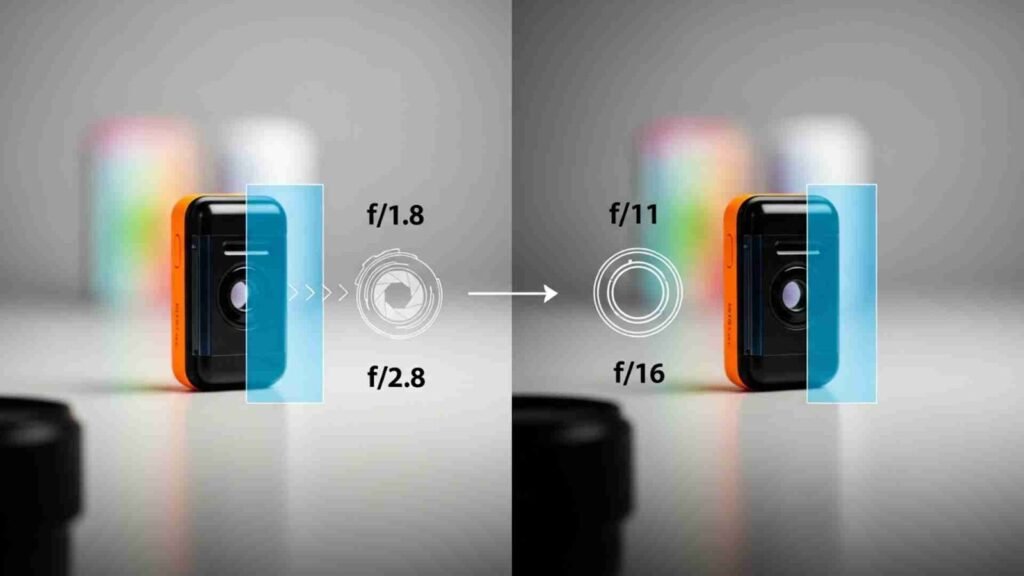
The f-stop number represents the size of the lens opening. Smaller numbers like f/1.8 or f/2.8 mean the lens is wide open. Larger numbers like f/11 or f/16 mean the lens is more closed. A wide aperture gives a shallow depth of field, making only a small part of the product sharp. A narrow aperture gives more depth, making everything look crisp.
In everyday portrait photography, people love a blurry background. In product photography, that blur often becomes a problem because customers need to see every angle and every detail. That’s why the Best F Stop for Product Photography tends to be somewhere between medium and narrow – usually f/7.1 to f/16.
But the “best” setting changes depending on the size of the product, the type of lens you’re using, your lighting conditions, and how close you are to the subject. That’s exactly why this guide goes deep and explains each scenario.
If you are looking for a quick, practical answer without diving into technical details, here it is:
Most professional product photographers use f/8 to f/11 as their go-to settings because these f-stops offer maximum sharpness, clean detail, and enough depth of field without suffering from diffraction.
However, the “Best F Stop for Product Photography” isn’t a one-size-fits-all rule. There are adjustments depending on what you’re shooting. Let’s explore these scenarios in more depth.
Small products like jewelry, watches, cosmetics, accessories, electronics, or handcrafted items require a greater depth of field. Since these items are photographed up close, your depth becomes naturally shallow. If you shoot at f/4 or f/5.6, parts of the object may go out of focus.
That’s why professionals working with macro lenses often rely on f/11 to f/16. These f-stops help you maintain sharpness across tiny details, like gemstones, engravings, textures, and product edges. This is especially important if your product will be featured on high-resolution websites, Amazon listings, catalogues, or magazines.
When photographing small products, the Best F Stop for Product Photography is usually on the narrower side because clarity matters more than background blur. And since macro setups typically use stronger lighting – like softboxes, diffusers, LED panels, or strobes – shooting at f/16 isn’t a problem at all.
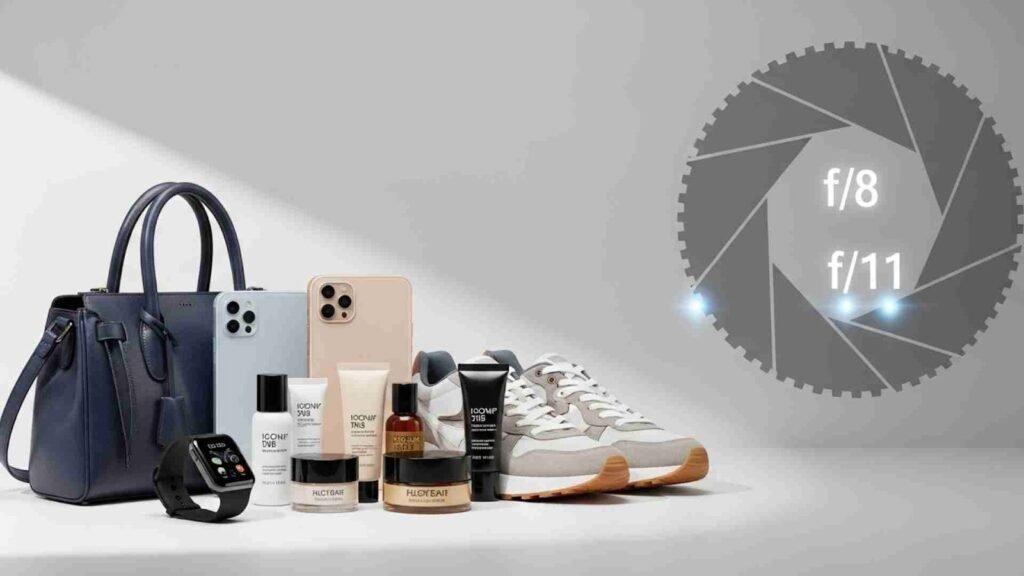
When you’re photographing shoes, handbags, skincare sets, tech gadgets, small appliances, or fashion accessories, you don’t need extremely narrow apertures. These products benefit from a balance of depth and sharpness.
For medium products, the Best F Stop for Product Photography typically falls between f/8 and f/11. This range ensures the entire product looks crisp but also gives your lens enough space to perform at its sharpest point. Most lenses are designed to produce their absolute best quality around the mid-range f-stops.
Whether you’re shooting on a white background for eCommerce or using a creative lifestyle setup for social media ads, f/8 to f/11 offers clean detail without requiring intense lighting.
Larger products like furniture, clothing on mannequins, home decor items, or bigger electronics don’t require extremely narrow apertures because you aren’t shooting super close to them. Even at wider apertures, you may still get enough depth.
For larger items, the Best F Stop for Product Photography is usually around f/5.6 to f/8. This keeps your images sharp while letting more light into the camera. Since large products often involve bigger sets, multiple lights, or wider compositions, slightly wider apertures help you maintain brightness without raising ISO too much.
This is also beneficial for lifestyle product photography, where you want the entire scene to look natural and evenly sharp.
Lighting is one of the biggest influences when choosing the Best F Stop for Product Photography. If you use strong lighting like strobes or high-power continuous LEDs, you can shoot comfortably at f/11 or f/16. If you’re using window light or smaller LEDs, you may need to stay around f/5.6 or f/8.
The stronger your light, the more flexibility you have to choose deeper apertures. In product photography, light quantity and light quality determine how confident you can be with narrow f-stops. That’s why many commercial product studios rely on at least one softbox and a fill light to ensure even coverage.
If you struggle with shadows, noise, or dark areas when using narrow apertures, consider boosting your lighting before adjusting your f-stop.
Beginners often think that using wide apertures will make their product photos look “professional,” but the opposite is true. Wide apertures create a shallow depth of field, blurring parts of the product that must be sharp.
Unless you’re doing very specific artistic photography – such as product lifestyle shots with a creative blur – f/1.8 or f/2.8 rarely work for commercial product photography.
When customers shop online, they want to see all parts of the product clearly. Blurry edges or soft areas reduce trust and lower conversions. That’s why medium to narrow apertures remain the Best F Stop for Product Photography.
Many people assume that if narrow apertures create more sharpness, then going even narrower will create even sharper photos. Unfortunately, this creates the opposite effect. Beyond f/16, most lenses begin to suffer from diffraction, producing soft images.
So although f/22 provides a deeper depth of field, the overall image may look less crisp. You want your image to look sharp, not mathematically deep.
This is why the sweet spot remains f/8 to f/16, depending on the size of the product and your lens.

Your lens plays a huge role in determining the ideal aperture. Different lenses behave differently at the same f-stop, which is why photographers always test their lenses to find their sharpest point. Even though the Best F Stop for Product Photography often falls between f/8 and f/11, the lens you use can shift that sweet spot slightly.
Prime lenses, such as a 50mm, 85mm, or 100mm macro, usually offer better sharpness and clarity at mid-range apertures. Macro lenses in particular are built to capture small details with incredible accuracy, making them perfect for jewelry, electronics, watches, and cosmetics. These lenses deliver maximum detail around f/8 to f/16, depending on how close you are to the subject.
Zoom lenses, like a 24-70mm or 70-200mm, also perform extremely well for product photography, especially when set to a focal length with minimal distortion. These lenses usually hit their best performance at f/7.1 to f/10. If you’re using a zoom lens in a studio environment, this range will give you enough depth without sacrificing detail.
The lens’s optical design also impacts diffraction, chromatic aberration, and corner sharpness. If your lens struggles with edge softness, using a slightly narrower aperture like f/11 can help tighten the entire image. This is why professional product photographers always test their lenses beforehand. It saves time during retouching and ensures consistency across product catalogues, especially when shooting for eCommerce brands.
One thing many beginners overlook is how distance affects the Best F Stop for Product Photography. The closer you are to your subject, the shallower your depth of field becomes – even if you’re using a relatively narrow aperture. This is particularly noticeable in macro photography, where even f/16 can still produce a shallow focus.
If you’re shooting extremely close to a product, you’ll often need to use a tighter aperture to keep everything sharp. Jewelry photographers experience this constantly. A ring, for example, might require f/14 or f/16 if the camera is only a few inches away.
If you’re shooting from a farther distance – such as photographing a chair, handbag, or clothing item – you won’t need such narrow apertures. In these cases, f/5.6 or f/8 can still deliver excellent sharpness.
Understanding how distance influences depth of field helps you adjust your aperture without guessing. It allows you to choose the Best F Stop for Product Photography based on physical conditions rather than just general recommendations.
Background selection is another factor that affects your ideal f-stop. Product photography usually falls into two categories:
clean background (white, black, grey, beige) and lifestyle background (scene, props, environment). Each style benefits from a slightly different aperture.
This style is used most frequently in eCommerce, especially for Amazon, Shopify, and brand websites. A clean background demands maximum product clarity and minimal distractions. For this reason, the Best F Stop for Product Photography on a white or solid background is generally f/8 to f/11. This ensures the product edges, textures, labels, and features all remain sharp.
If you’re using a macro lens or photographing small items, you might push to f/14 or f/16, but normally f/11 is enough.
Lifestyle images allow more creative freedom. Here, you might want a slight depth variation so the subject stands out against the scene. You don’t need the entire frame pin-sharp – just the product.
For lifestyle product photography, the best range is often f/4 to f/8. This gives you enough depth to keep the product sharp while letting the background fall slightly soft. But the product must always remain in perfect focus – even in lifestyle shots – so avoid shooting too wide unless the composition is intentional.
Lighting modifiers such as softboxes, diffusers, umbrellas, reflectors, and strip lights impact how much light hits your product. This influences your aperture because each modifier changes brightness and shadow softness.
If you use large softboxes or diffusers, the light spreads out and softens, providing even illumination. This allows you to comfortably use f/11 or f/16 without worrying about noise or dark shadows. If you’re working with continuous LED lights, you may have to adjust your aperture wider – perhaps f/5.6 or f/7.1 – to maintain proper brightness.
Reflectors can bounce light into shadow areas, helping you use a narrower f-stop without losing exposure. Strip lights are helpful for tall or glossy products because they create beautiful highlights along edges.
Strobes and studio flashes give you the most flexibility. A single 200-400W strobe can easily support f/16 at ISO 100, meaning your product shots stay clean, crisp, and noise-free. This is why most professional studios favour strobes – they allow full control over the Best F Stop for Product Photography.

Although narrow apertures dominate product photography, there are situations where wider apertures are not only acceptable but ideal.
Here are some examples:
If you’re shooting a product in a real environment – a perfume bottle on a marble counter, or a coffee mug beside a book – a slightly blurred background adds atmosphere. In this case, f/2.8 to f/4 can look beautiful as long as the product stays fully sharp.
High-end advertising sometimes intentionally adds background blur to draw attention to the subject. This is common in beverage photography, food photography, and editorial-style product images.
If you’re shooting in natural light without studio equipment, you may need to widen your aperture to avoid increasing ISO. In this scenario, f/4 to f/5.6 becomes practical.
These creative choices exist, but they do not replace the traditional Best F Stop for Product Photography, which stays between f/8 and f/16 for most commercial applications.
Sensor size plays a more important role than many people realise. Full-frame sensors handle narrower apertures better because they have larger pixels and typically manage diffraction more gracefully. If you’re using an APS-C or Micro Four Thirds camera, you might notice diffraction appearing earlier – starting at f/11 or f/13.
This means that the Best F Stop for Product Photography may vary slightly:
These differences help you optimise your images based on your sensor size. It’s not about which camera is better – it’s about choosing the right aperture for the system you already use.
Every brand wants images that not only look good but also convert into sales. Sharpness increases trust, improves perceived value, and helps buyers understand the product. The right f-stop helps you achieve sharpness naturally, reducing the amount of retouching needed and ensuring your photos look consistent across a catalogue.
Online shoppers make decisions within seconds. If your images look soft, blurry, or inconsistent, they assume the product is low quality – even if it’s excellent. This is why the Best F Stop for Product Photography directly influences your conversions and brand reputation.
Even though the concept of aperture seems simple in theory, a lot of product photographers – especially beginners – make mistakes when adjusting their f-stop. These mistakes often result in blurry images, underexposure, noise, or even unwanted shadows. Understanding these pitfalls helps you confidently select the Best F Stop for Product Photography in any situation.
One of the most common mistakes is choosing an aperture that is too wide. Many beginners leave their lenses at f/2.8 or f/4 because the background looks nice and blurry. But in product photography, this blur works against you. If the front of the product is sharp but the back is soft, the image loses commercial value. Customers want clarity, not artistic blur, especially in eCommerce.
Another mistake is stopping the lens down too far. Some photographers assume that f/22 or f/32 will make everything razor-sharp from every angle. Instead, these small apertures often cause diffraction, which softens the image. Even though your depth of field increases, your overall sharpness takes a hit. That’s why the Best F Stop for Product Photography stays within the mid-range, where lenses perform at their optical peak.
Relying too heavily on the camera’s autofocus can also cause issues. Even the best autofocus systems sometimes focus slightly off, especially on small products like jewelry or electronics. If your focus point lands on the wrong detail, the rest of the product may appear slightly soft – even if you’re using the correct f-stop. Always zoom in on your preview screen to check whether your subject is truly sharp.
Using insufficient lighting is another major issue. Without proper lighting, you may be forced to widen your aperture, raise your ISO, or slow down your shutter speed. This can introduce noise, motion blur, or reduced sharpness. A strong lighting setup allows you to use the Best F Stop for Product Photography without compromise.
Finally, shooting too close to the product without accounting for the shallow depth of field can lead to partial blur. This happens often in macro photography. The closer you are, the narrower your aperture needs to be. Always adjust your f-stop based on how close your camera sits to the subject.

Sometimes even the Best F Stop for Product Photography isn’t enough, especially when shooting very small items like gemstones, mechanical parts, or textured accessories. If you’re extremely close to the subject and need full sharpness from front to back, even f/16 may not give you enough depth of field. This is where focus stacking becomes invaluable.
Focus stacking involves taking multiple images, each with a slightly different focus point. You then blend these images in post-production to create a final image that is fully sharp throughout. This technique is popular in jewelry photography, luxury product shoots, and macro work.
Using focus stacking allows you to keep your f-stop in the sharpest range – usually f/8 or f/11 – while still capturing full depth. This eliminates diffraction problems and creates crisp, high-end results. It also reduces the need for heavy retouching later. While not necessary for every type of product, it’s a powerful option for small items or close-up shots where detail matters.
Products come with different textures – glossy, matte, metallic, rough, or transparent. These surfaces reflect and absorb light differently, meaning your aperture choice may shift accordingly.
Reflective products like glass, chrome, jewelry, or polished metal require careful control of highlights. A narrower aperture often helps reduce blown-out highlights and capture the entire reflective surface with precision. For these items, the Best F Stop for Product Photography typically falls around f/11 to f/16.
Matte surfaces benefit from showcasing their texture. Using an aperture like f/8 to f/11 helps bring out subtle details without making the image too flat. This is especially helpful for skincare products, clothing, food items, and textured decor.
Photographing glass bottles, perfume, beverages, or acrylic items requires a balanced aperture. Too narrow, and you will capture distracting reflections; too wide, and you lose depth. A balanced setting around f/7.1 to f/9 works well for transparent subjects.
Although many photographers prefer studio lighting, natural light still has its charm and usefulness. Your aperture choice should adjust depending on the source of your light.
Natural light is softer and less intense, which means you may need a slightly wider aperture to maintain proper exposure. In natural light setups, the Best F Stop for Product Photography often falls between f/5.6 and f/8. This range gives enough depth without forcing you to increase ISO.
However, natural light is inconsistent. Clouds pass, sunlight shifts, and shadows move. If you depend on natural light, you may need to adjust your aperture throughout the shoot.
Studio lights give you complete control over brightness, shadow, and diffusion. With strobes or strong continuous lights, you can comfortably choose a narrower aperture – often f/11 to f/16 – without worrying about noise or motion blur.
Studio lighting always offers the most flexibility, which is why commercial product studios prefer it for consistent results.
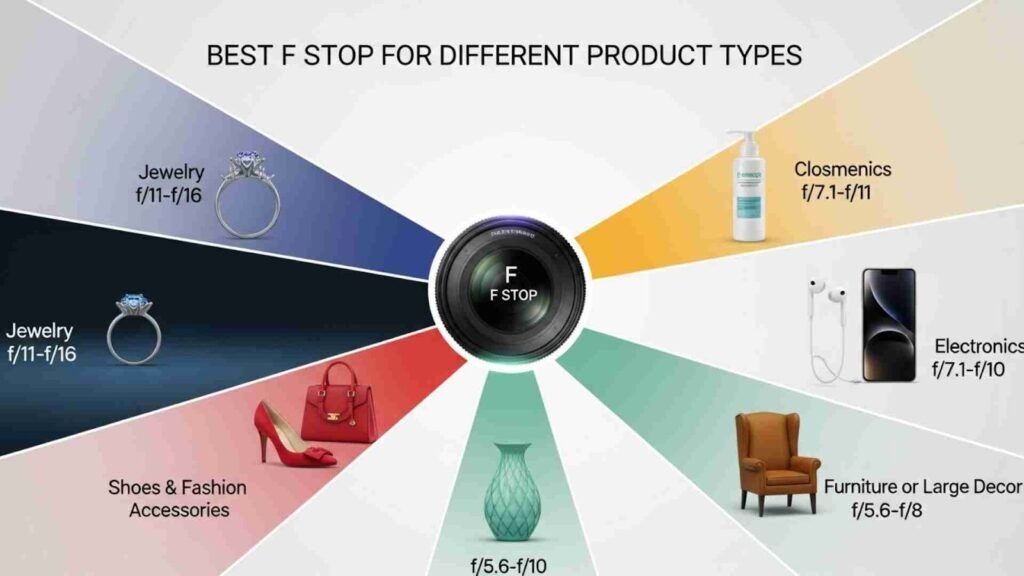
Here are real-world scenarios showing how professionals choose the Best F Stop for Product Photography for various product categories.
Macro work with great detail. Best range: f/11 to f/16.
Clean backgrounds and lifestyle shots. Best range: f/8 to f/11.
Avoid reflections; maintain sharp edges. Best range: f/7.1 to f/11.
Medium-sized items. Best range: f/8 to f/10.
Larger items with more distance between the camera and the subject. Best range: f/5.6 to f/8.
These examples help reinforce the idea that the Best F Stop for Product Photography is not universal – it’s contextual.
While this guide explains the practical rules and recommended ranges, every photographer eventually discovers their personal sweet spot. The conditions, style, product type, lens, and lighting all affect the final choice. But if you want a reliable, beginner-friendly recommendation:
These simple guidelines will lead you to sharp, professional, selling-ready images almost every time.
Whenever you feel unsure, remember the golden rule:
If the product isn’t fully sharp, stop down your aperture.
If the image starts to look soft from diffraction, open the aperture slightly.
This balancing act is what makes photography both technical and creative.
Selecting the Best F Stop for Product Photography is more than just a technical choice – it’s a business decision. Your product images act as your online salesperson. They communicate quality, trust, and value before the customer ever clicks “Buy.” The sharper and clearer your images are, the more likely customers will convert.
Every product deserves to be presented at its best, and choosing the right f-stop is one of the simplest ways to elevate your photography instantly. Whether you’re shooting for Amazon, Shopify, Etsy, your brand website, or a full commercial campaign, the right aperture ensures you capture the product exactly as it should be seen.
Great product photos don’t just look attractive – they sell.
At aitinsider, we specialise in professional image editing, product retouching, background cleanup, shadow creation, colour correction, and high-end detail enhancement. If you want your product photos to look sharp, clean, and premium – even if they weren’t shot with the perfect f-stop – our team can transform them into selling-ready images.
Whether you’re a photographer, eCommerce seller, or brand owner, aitinsider gives your images the polished, professional finish they deserve.
When you’re ready to take your product photos to the next level, aitinsider is here to help you look your best.