
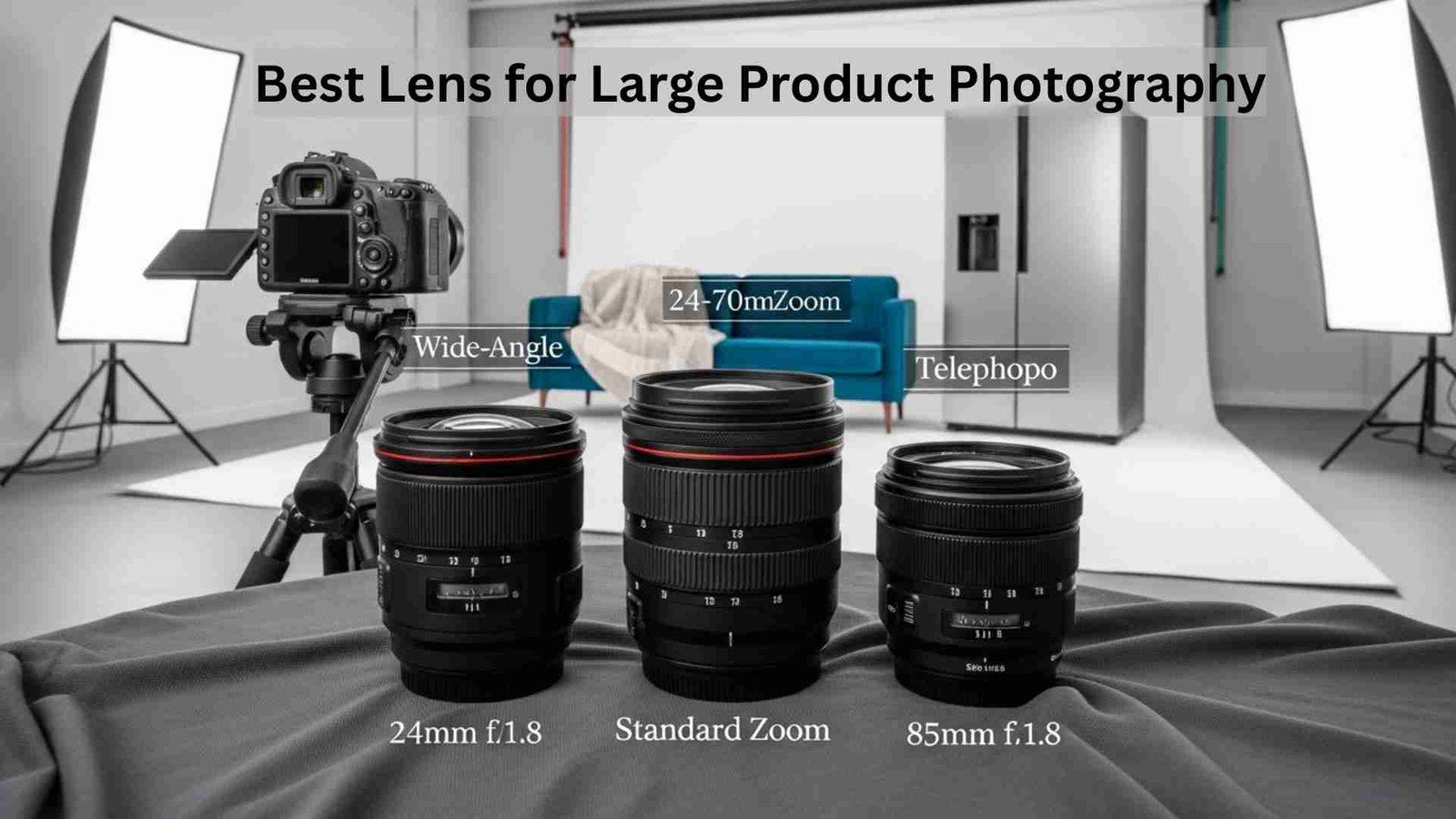
When it comes to photographing large products like furniture, refrigerators, washing machines, sofas, cabinets, gym equipment, bikes, or even oversized packaging, the lens you choose can make or break the final image. That’s exactly why so many photographers search for the Best Lens for Large Product Photography when planning their studio setup or upgrading their equipment.
The goal of this guide is to help you understand which lenses truly work best for big items, what focal lengths matter, how to avoid distortion, and how to get clean, professional-looking results every time. Since this article is written for Aitinsider readers, we’ll keep it simple, friendly, and super practical, just like talking to a teammate in your studio.
This is a Commercial-Intent keyword, so the entire article is written to genuinely help readers compare their options and choose the Best Lens for Large Product Photography based on real-world performance.
Let’s get started.
Shooting large items is a completely different experience compared to photographing small objects like jewellery, perfumes, or electronics. Large products often take up most of the frame, require more space, and are trickier to light without reflections and shadows.
This is where the Best Lens for Large Product Photography becomes extremely important, because the wrong lens can cause issues like stretching, bending, perspective distortion, and uneven lines, things that are NOT acceptable in commercial product imagery.
When photographing large items, you’re not just capturing the product; you’re capturing shape accuracy, texture, proportions, and size representation. For example, if you shoot a sofa with the wrong lens, the edges can curve, making the product look cheaper or poorly built. For appliances like refrigerators or ovens, straight lines are essential to maintain a professional look.
So the lens you choose must provide:
These factors will guide us as we determine the Best Lens for Large Product Photography for furniture, appliances, and other oversized items.
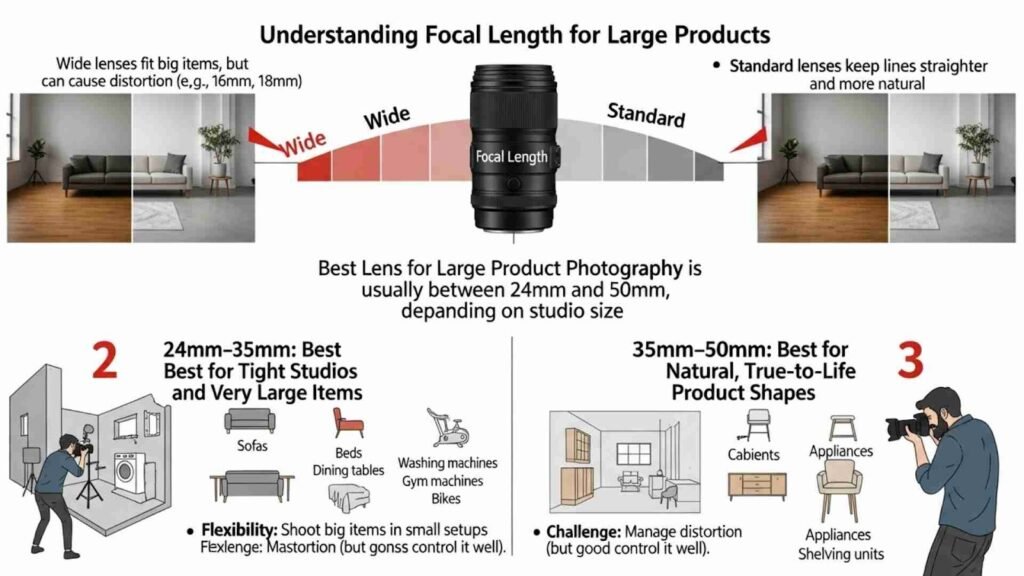
Before jumping into lens recommendations, you need to understand focal length. For large product photography, focal length is the most important technical factor.
To make it easy:
Wide lenses let you fit big items into the frame, while
Standard lenses keep lines straighter and more natural.
But the trick is finding the perfect balance between width and accuracy, because too wide a lens, like 16mm or 18mm, causes distortion, making products appear warped or inflated.
That’s why the Best Lens for Large Product Photography is usually somewhere between 24mm and 50mm, depending on your studio size.
Let’s break down the focal lengths:
If you shoot inside a small studio or room and don’t have much space to step back, a 24mm or 28mm lens helps you fit large products into the frame.
This range is great for:
The key advantage is flexibility; you can shoot big items even when working in a small setup. The main challenge is managing distortion, but good lenses in this range control distortion surprisingly well. With the right perspective and editing (which Aitinsider can help with), these lenses deliver clean, accurate images.
Photographers love this range because it offers the easiest framing for oversized products.
If you want your products to look as natural as possible with minimal distortion, lenses from 35mm to 50mm are ideal. These focal lengths keep shapes realistic and lines straight.
They’re perfect for:
Many professionals consider the 35mm the Best Lens for Large Product Photography because it balances wide framing with natural proportions.
But if you have enough space to step back, a 50mm lens gives the most accurate, undistorted view of big products. For commercial catalogue photography, especially for stores that sell furniture or appliances, 50mm is often the top choice.
One of the most popular choices for shooting large products is the classic 24–70mm zoom lens. Almost every full-frame system, Canon, Sony, and Nikon, has a version of this lens, and it’s reliable, sharp, and flexible.
If someone asks, “What is the Best Lens for Large Product Photography for everyday studio use?”
The 24–70mm is the easiest answer because:
This lens adapts to whatever the studio throws at you. One moment you’re shooting a dining table at 28mm, and the next you’re capturing product details at 70mm, all without switching lenses.
For businesses that photograph multiple large products daily, the 24–70mm is often the most efficient and cost-effective tool.
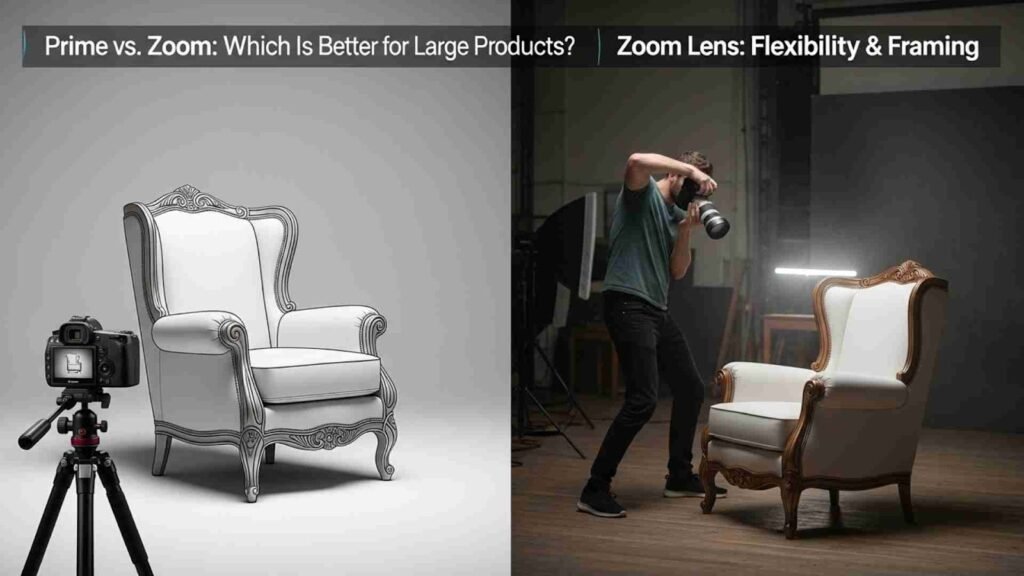
Many photographers wonder whether they should use prime lenses or zoom lenses.
Prime lenses give you:
On the other hand, zoom lenses give you flexibility in framing, which is useful when photographing big, heavy items that are hard to move around.
If your goal is pure image quality and consistency, primes like 35mm and 50mm are extremely strong choices and often considered the Best Lens for Large Product Photography when accuracy matters most.
But if flexibility is more important, for example, in a busy studio, a zoom lens might suit you better.
Even though the keyword focuses on “Best Lens for Large Product Photography,” many readers have different camera systems. So here’s a simple explanation without turning this into a spec-heavy comparison.
Canon’s RF and EF lens lineup includes excellent choices like:
Canon users love the RF 24–70mm because it’s sharp, flexible, and has excellent distortion control.
Sony’s G Master lenses are extremely sharp:
Sony cameras pair really well with wide-angle lenses thanks to powerful in-camera corrections.
Nikon has strong Z-mount lenses, such as:
These lenses are known for their color accuracy and clean lines, essential for large products.
Regardless of brand, the principles remain the same, and all the lens recommendations fit the category of Best Lens for Large Product Photography across full-frame camera systems.
This is something many beginners overlook:
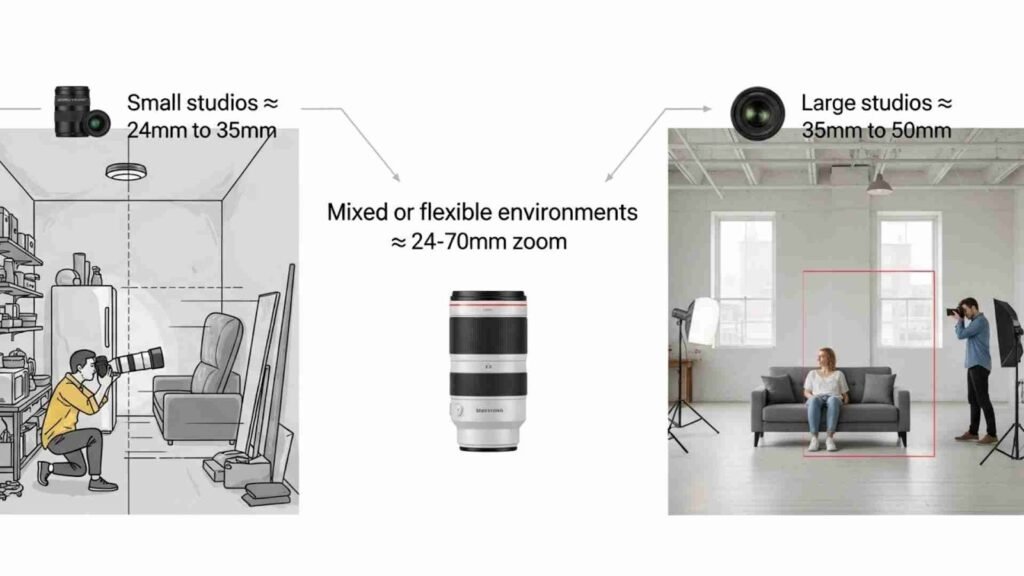
Your studio size directly determines which lens you should buy.
If your studio is small, you may not be able to step back far enough to shoot big items with a 50mm lens. In that case, a 24mm or 28mm becomes the Best Lens for Large Product Photography simply because you need the extra width.
But if you shoot in a spacious warehouse or a commercial studio, 35mm or 50mm will give you cleaner results and less distortion.
A simple rule of thumb:
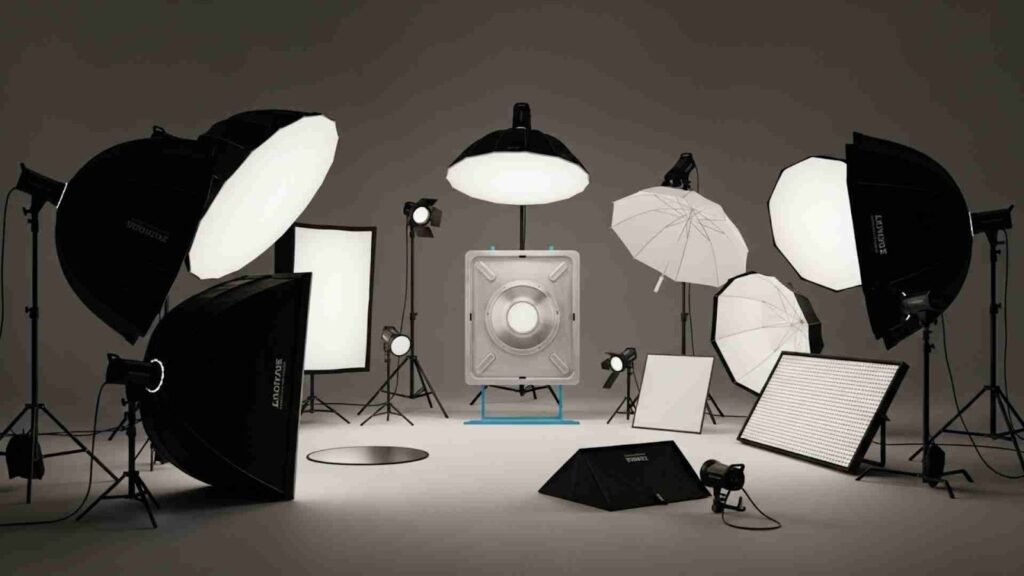
While picking the Best Lens for Large Product Photography is crucial, lighting plays an equally important role. Large products need large, soft lighting to avoid harsh shadows and reflections. This is where:
All become essential tools.
Even the best lens cannot fix poor lighting, so pair your lens choice with a good studio lighting setup for the best results.
When you work with big items like furniture, kitchen appliances, gym equipment, bicycles, or oversized décor pieces, the way you choose your lens becomes even more important. This is why photographers and eCommerce brands look for the Best Lens for Large Product Photography, because large items introduce challenges that smaller products don’t. Before reviewing the specific lens options, let’s take a moment to understand the real-world problems you might face while shooting large products and how your choice of lens can solve them.
When photographing large items, the first challenge is the limited space in your studio or shooting area. Even if you have a decently sized room, you often need to position yourself far back to fit the entire product into the frame. If you use the wrong focal length, you may either be forced too close, causing distortion, or too far back, making lighting and composition harder. This is why wide-angle and standard zoom lenses are considered the Best Lens for Large Product Photography; they help you work efficiently even when space is restricted.
Another major issue is perspective distortion, something that becomes extremely noticeable with large products. When you use ultra-wide lenses (for example, 10mm or 12mm), furniture and appliances can start to look stretched or warped. Straight edges may appear to bend outward, legs may look longer than they actually are, and corners may distort. This is a huge problem for online stores because customers expect accurate dimensions. A lens with the right focal length, usually in the 24–70mm range, helps avoid this distortion, making it the Best Lens for Large Product Photography when accuracy is essential.
Lighting is also a big factor. Larger products cast bigger shadows and require more balanced lighting to look clean and professional. The right lens will allow you to position your lights correctly without unwanted shadows, hotspots, or colour shifts. A lens with good sharpness and contrast helps capture the true texture and colour of wood, metal, leather, fabric, and polished surfaces. That’s another reason choosing the Best Lens for Large Product Photography matters; no brand wants their furniture or appliances looking dull or inaccurate.
Large-product photography also requires more attention to depth of field. When shooting something like a large cabinet or a washing machine, the front may be sharp while the back looks soft if you use a lens with a very wide aperture. Using a lens known for clarity across the frame gives you consistent sharpness from edge to edge. This is a key reason professional photographers trust lenses like the 24–105mm, 24–70mm, or 35mm primes; they provide excellent field sharpness, making them contenders for the Best Lens for Large Product Photography.
You also need to think about working distance, especially if you’re shooting in-studio. A lens with a flexible zoom range allows you to move around your scene and adjust quickly while keeping the product straight and evenly framed. Instead of moving the product (which can be heavy), you can simply adjust your lens. This convenience is another reason people search for the Best Lens for Large Product Photography; the right lens saves time, energy, and effort in every shoot.
Finally, large items need accurate shape representation, especially for eCommerce. A sofa must look like its real-life size. A refrigerator cannot appear taller or slimmer than it really is. The right lens preserves the geometry of the product, making it essential for brands that care about reducing returns. This makes selecting the Best Lens for Large Product Photography a smart business decision, not just a creative one.
Understanding these challenges sets the foundation for intelligently choosing the Best Lens for Large Product Photography. Now that we have covered what makes large-product photography unique, let’s explore the best lens choices for different types of big items, sofas, beds, cabinets, home décor, appliances, gym machines, and more.
Let’s dive deeper into the specific lenses next.
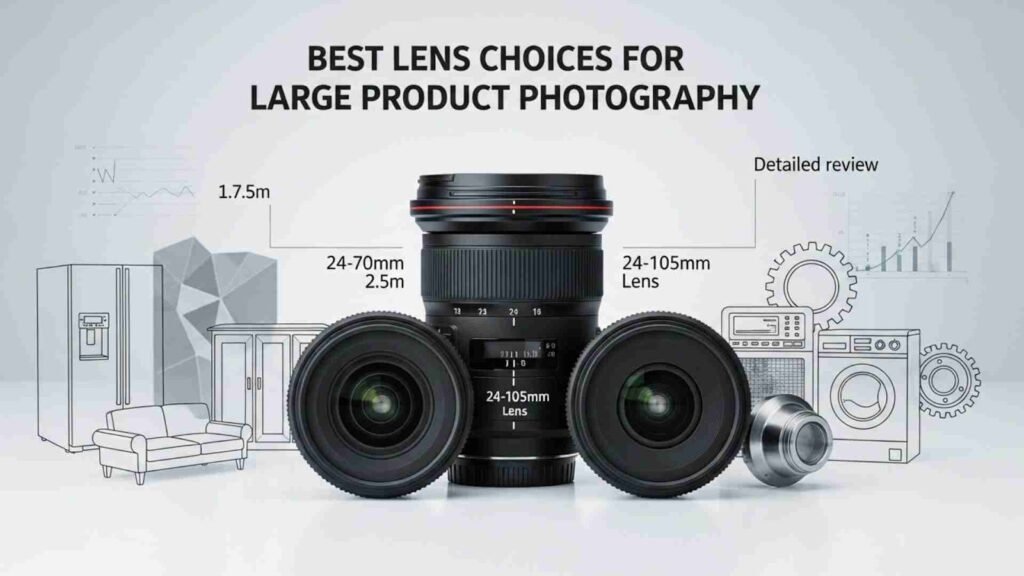
Now that you understand why the lens matters so much, let’s go through the lenses that truly earn the title of Best Lens for Large Product Photography, and why professionals in furniture photography, appliance photography, and industrial product photography rely on them.
One of the most popular options for shooting large items is the 24–70mm lens. Many professionals consider this range the Best Lens for Large Product Photography simply because it gives the perfect balance of width and accuracy. At 24mm, you get enough width to capture most large products even in medium-sized studios without bending lines unnaturally. As you zoom toward 50mm or 70mm, you get a more natural perspective, which is great when you want to highlight specific features like wood texture, control panels, stitching, or handles.
This lens is also incredibly sharp, especially the f/2.8 versions. Even though you won’t shoot large products at f/2.8 (you’ll use f/8 to f/11 for proper depth), the optical quality ensures all your images look crisp and professional. This range is often considered the Best Lens for Large Product Photography because it eliminates distortion and fits a wide range of product sizes, whether you’re photographing a small cabinet or a king-sized bed.
If you want a bit more flexibility, the 24–105mm lens is another lens that professionals consider the Best Lens for Large Product Photography. The extra reach helps you get tighter, detail-oriented shots without switching lenses. You can photograph the entire furniture set at 24mm, then zoom in at 105mm to capture textures like leather grain, wood patterns, or appliance buttons.
Because large items require consistent framing, the 24–105mm range helps you adjust quickly without moving back and forth across your studio, a big advantage when working with bulky items. This is why many eCommerce photographers and product studios consider this lens the Best Lens for Large Product Photography for both full shots and close-ups.
Another classic option is the 35mm prime lens. Many furniture and interior photographers believe this focal length produces images that feel natural without distortion. If you want a lens that gives a true-to-life representation, the 35mm is one of the best options. It’s particularly useful when photographing large products in lifestyle settings, such as sofas in living rooms, tables in dining areas, or appliances in styled kitchens.
This makes the 35mm a strong candidate for the Best Lens for Large Product Photography when your focus is realism, authenticity, and interior-style product presentation.
Now that we’ve reviewed the most popular and reliable options, it’s time to focus on choosing the Best Lens for Large Product Photography based on the actual products you’re shooting. Different types of large items require different focal lengths because each product has a unique size, shape, texture, and intended presentation style. This section will help you make the perfect choice whether you’re shooting furniture, appliances, décor, machinery, or oversized equipment.
When you’re photographing furniture, such as sofas, beds, dining tables, or wardrobes, maintaining accurate proportions is crucial. Clients want their furniture to look realistic and true to size. For this category, the Best Lens for Large Product Photography is usually something in the 24–70mm range. At 24mm, you can capture the entire product even in tighter rooms, while 35mm–50mm provides more natural shape representation. This balance is especially helpful when shooting bedroom sets, chairs, or coffee tables, where viewers expect straight lines and proper scale.
For home appliances, such as refrigerators, washing machines, air conditioners, or microwave ovens, the 35mm or the 24–105mm lens often becomes the Best Lens for Large Product Photography because appliances have hard edges, straight lines, and reflective surfaces. Using an overly wide focal length can distort the edges, while using a focal length that’s too long might require too much space. A 35mm or the mid-range of the 24–105mm lens provides clean and accurate proportions without distortion.
When shooting large décor items like big mirrors, standing lamps, wall art, or oversized plants, the 50mm mark often gives you the most pleasing results. Décor must look natural and elegant, and the Best Lens for Large Product Photography in this scenario is one that doesn’t exaggerate angles or warp reflections. The 50mm focal length preserves realism while giving you enough room to move around your lighting setup.
For industrial products, such as machinery parts, commercial equipment, or heavy-duty tools, the 24–70mm or 70–200mm lens may be needed, depending on how large the items are. Some industrial products require you to stand far back to capture their full shape. In these cases, telephoto lenses become the Best Lens for Large Product Photography because they help compress the perspective while keeping lines straight and details crisp.
Photographing oversized items, such as gym equipment, treadmills, bicycles, or large outdoor items, often requires wide framing but minimal distortion. Here, the 35mm lens or the wider side of a 24–105mm zoom becomes the Best Lens for Large Product Photography because it helps you work in limited rooms without warping shapes or stretching the frame too much. These products must look sturdy and balanced, so accuracy is everything.
If your studio space is small and you struggle with stepping back far enough, a 24mm lens gives you flexibility. However, if space isn’t an issue, the 35mm or 50mm focal lengths often look cleaner and more professional. The real trick in choosing the Best Lens for Large Product Photography is finding that sweet spot where your lens matches your shooting environment, lighting setup, and product size.
The larger the product, the more carefully you need to avoid distortion.
This means avoiding ultra-wide lenses unless necessary. Using properly calibrated zoom lenses like the 24–70mm or 24–105mm helps you adapt quickly and ensures your product images look consistent across all shots.
With this understanding, you now have a clear idea of how to select the Best Lens for Large Product Photography based on the type of product, your studio size, and the style of final images your clients want.
Choosing the Best Lens for Large Product Photography is only half the job. The other half is setting your camera correctly so that the photos look clean, consistent, and ready for editing or online publication. Shooting large products requires a balance of sharpness, depth, clarity, and controlled lighting. Let’s walk through the most effective settings in a simple, beginner-friendly way.
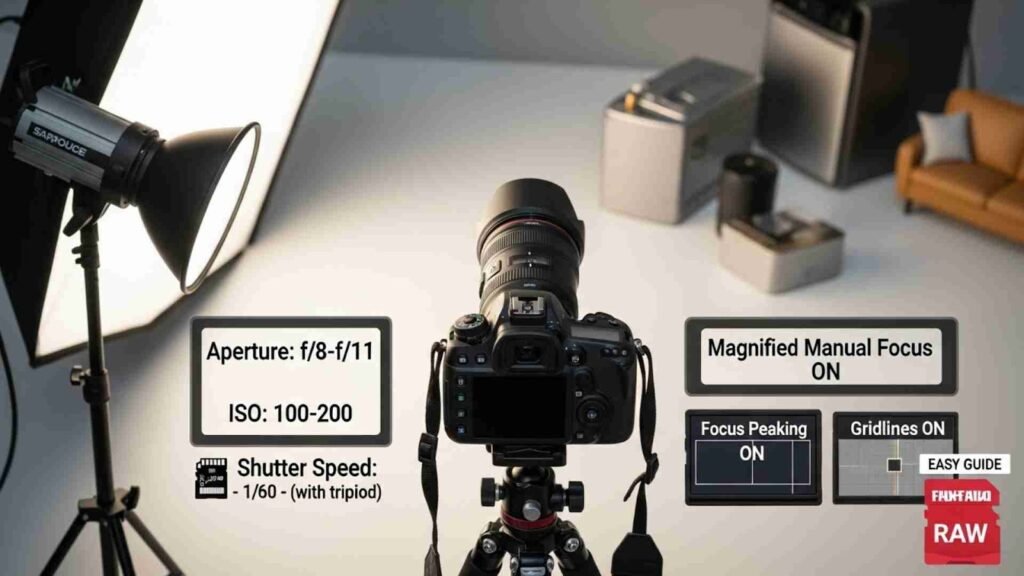
When photographing large items, the most important setting is your aperture. You’ll want to use a narrower aperture, usually around f/8 to f/11, to make sure the entire product stays in focus. Large products often have depth, meaning the front and back of the product might not be equally sharp if the aperture is too wide. Using a controlled aperture ensures every detail is captured, helping your Best Lens for Large Product Photography produce sharp results across the whole frame.
Next is your ISO setting, which should stay as low as possible. ISO 100 or 200 is perfect because it minimises noise. Large products often require heavy lighting, and studio lights can easily handle low ISO settings. The Best Lens for Large Product Photography will give you clear images, but low ISO levels ensure the sensor captures clean data without grain, making post-production easier.
Your shutter speed depends on whether you’re using a tripod. For large product photography, a tripod is strongly recommended because you want consistent angles from shot to shot. With a tripod, you can use slower shutter speeds like 1/60, 1/80, or even slower if you’re using controlled lighting. Your Best Lens for Large Product Photography will produce sharper results when paired with stable shooting.
Another key setting is white balance. Large products often come in different materials, wood, metal, plastic, and glass, each reflecting light differently. Setting your white balance manually ensures accurate colour representation. This matters especially for online shoppers who want to see the true colour of a sofa, a metallic appliance, or a painted cabinet. Even the Best Lens for Large Product Photography cannot fix inaccurate white balance unless the camera is set correctly.
You’ll also benefit from turning on focus peaking or magnified manual focus if your camera supports it. Large products often have lines and angles that need to be perfectly sharp, and manual focus helps you control exactly where your focus lands. Even though the Best Lens for Large Product Photography provides excellent autofocus, manual focusing gives you precision that guarantees professional results.
If you want perfectly straight lines and a balanced frame, enable gridlines on your camera to help align the product. This prevents tilting and keeps the product centred. Many photographers make this a permanent part of their shooting workflow, especially those using the Best Lens for Large Product Photography for catalogue and eCommerce shoots.
Finally, always shoot in RAW format. RAW files give you full control during editing, especially when dealing with large items that require colour correction, shadow adjustments, or background fixes. A RAW file contains the maximum amount of detail your Best Lens for Large Product Photography can capture, ensuring flawless editing quality.
Using these settings consistently ensures sharp, accurate images that display your products in the best possible way. With the combination of the right lens and the right settings, your photography becomes more efficient, repeatable, and client-friendly.
Lighting large items can be tricky because the bigger the object, the more shadows it casts,and the more space your lighting needs to cover. Even if you’re using the Best Lens for Large Product Photography, the results won’t look professional unless the lighting is clean, balanced, and soft. Large products need even illumination to show accurate color, surface quality, and structure. Let’s explore how to create beautiful, consistent lighting for furniture, appliances, gym equipment, and other oversized items.
When it comes to large products, the most important thing is soft light. Soft light reduces harsh shadows and makes the product look clean and premium. To achieve this, you can use big softboxes, large diffusers, or umbrella lights. The larger your modifier, the softer and smoother your lighting becomes. This allows your Best Lens for Large Product Photography to capture all details without distracting shadows or bright hotspots.
Another useful trick is creating a fill light to balance your scene. Large products tend to have deep corners or curves, which can appear too dark if only one light is used. Adding a fill light or even a simple white reflector can eliminate unwanted shadows. Professional studios often use two key lights, one on each side, to ensure the product looks natural and evenly lit. Your Best Lens for Large Product Photography will then pick up clean edges and textures without uneven dark areas.
The direction of your light matters too. Side lighting helps bring out textures in furniture, upholstery, wood grain, and fabric, while front lighting works well for glossy surfaces like refrigerators, washing machines, or stainless steel appliances. Knowing how to position your light allows the Best Lens for Large Product Photography to capture the product in the most flattering way.
For reflective products like fridges, ovens, and metal furniture, reflections can be a major problem. Here, you’ll need broad diffusers and careful positioning to avoid seeing yourself or your studio equipment in the product’s surface. Even the Best Lens for Large Product Photography can’t hide reflections, so controlling reflections is essential.
You can also add backlighting to separate the product from the background. This works surprisingly well with large, dark-colored objects or items placed against white seamless backdrops. Backlighting adds dimension, making the product feel more premium and less flat. Pairing backlighting with the Best Lens for Large Product Photography gives your final images a clean, catalogue-quality look.
Lastly, controlling lighting consistency is key if you’re shooting an entire product line. Your setup should remain the same for all angles and variations. This ensures uniformity across product pages, a major advantage for eCommerce stores. Consistent lighting plus the Best Lens for Large Product Photography results in images that match perfectly, making your online catalogue look professional and trustworthy.
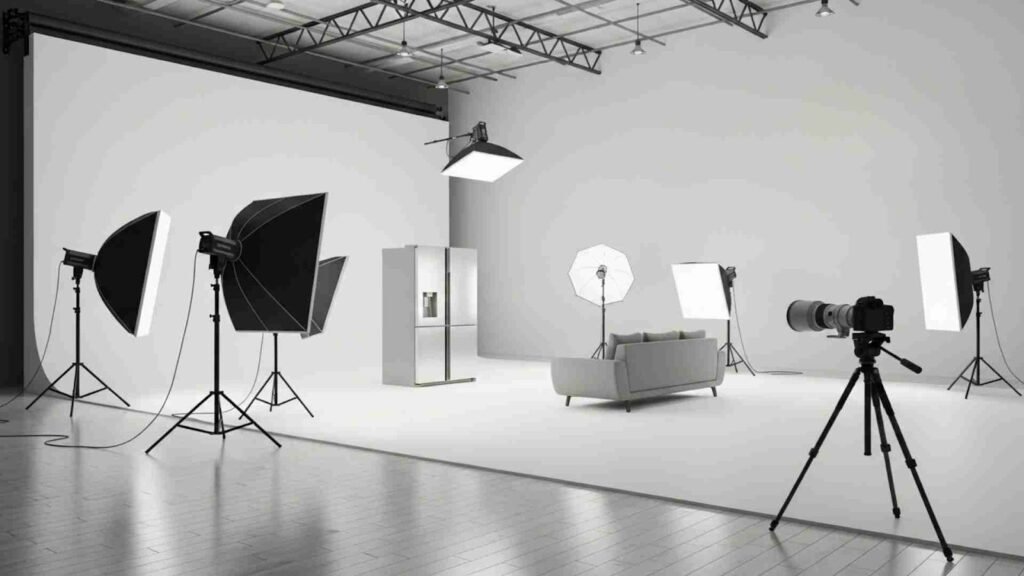
Large-product photography requires more space and planning than typical tabletop product photography. Your studio setup can make or break your shoot, even if you’re using the Best Lens for Large Product Photography. Here’s how to create an efficient and professional studio environment for big items.
Start with the background. For large products, white seamless paper, vinyl, or fabric backdrops are ideal. They create a clean, distraction-free environment that highlights the product. If you’re photographing furniture, lifestyle backdrops or staged environments also work well. The main goal is to ensure the shape of the product is clear, and the viewer’s attention stays where it belongs. When paired with the Best Lens for Large Product Photography, simple backgrounds look elegant and professional.
Next, think about space. Shooting large items requires more room to move around. Ideally, you should have at least 10–15 feet of distance between the product and the camera. This allows your Best Lens for Large Product Photography to capture the entire subject without distortion. More space also gives you room to position lights, modifiers, and reflectors properly.
Your flooring also matters. Large products often sit directly on the floor, so using a clean, smooth surface (white vinyl, wood-style floors, or polished tiles) enhances the final presentation. Flooring can reflect light onto the product in a pleasant way, especially when photographing modern appliances or stylish furniture.
Even experienced photographers make mistakes when working with oversized items. Knowing what to avoid ensures your images look polished and professional. Even the Best Lens for Large Product Photography cannot correct these issues once the shot is taken, so it’s better to avoid them entirely.
One of the most common mistakes is using ultra-wide lenses. While they may help you fit the product into the frame, they also distort the shape, making furniture legs look longer, or appliance edges appear curved. Stick to lenses like the 24–70mm or 35mm to avoid unnatural distortion. The Best Lens for Large Product Photography is one that keeps the product looking true to life.
Another mistake is improper lighting placement. Harsh, small lights create deep shadows that look unprofessional. Using larger softboxes and diffusers spreads the light evenly, enhancing textures while minimising imperfections. Your Best Lens for Large Product Photography will then capture clear lines and accurate tones.
Some photographers also fail to clean or prepare the product. Large items show fingerprints, dust, smudges, and dents more easily. Always wipe down the surface before shooting. It saves hours of editing time and ensures cleaner results, even before retouching.
Incorrect camera height and angle is another issue. Shooting from too high or too low can make the product look distorted or unnatural. The Best Lens for Large Product Photography works best when the camera matches the product’s natural perspective, giving the viewer a realistic experience.
Relying too much on post-production is another mistake. Even though editing software can fix certain issues, nothing replaces a clean, well-lit image captured with the Best Lens for Large Product Photography. The cleaner your raw image is, the more professional your final output will be.
Avoiding these mistakes helps ensure that your work looks high-end, polished, and visually appealing, even before editing.
Don’t forget the camera height. For most large-product shots, placing your camera around mid-height of the product creates a natural perspective. For example, photographing a sofa from slightly above seat level gives the most accurate representation. Using a tripod ensures that the Best Lens for Large Product Photography maintains consistent angles and height for all your shots.
You should also leave enough space behind the product. Allowing at least three to five feet between the product and the backdrop helps avoid shadows on the background while giving your lighting more room to breathe. This creates that clean, floating look you see in high-end catalogues. The Best Lens for Large Product Photography will then capture smooth gradients and clean outlines with zero background distractions.
Finally, think about workflow efficiency. Arrange your studio in a way that allows you to rotate the product, reposition lights quickly, and access your camera easily. Shooting large items can be physically tiring, so having an organised workflow helps you work faster and maintain consistency. With the right space, lighting, and layout, the Best Lens for Large Product Photography will deliver stunning results every time.
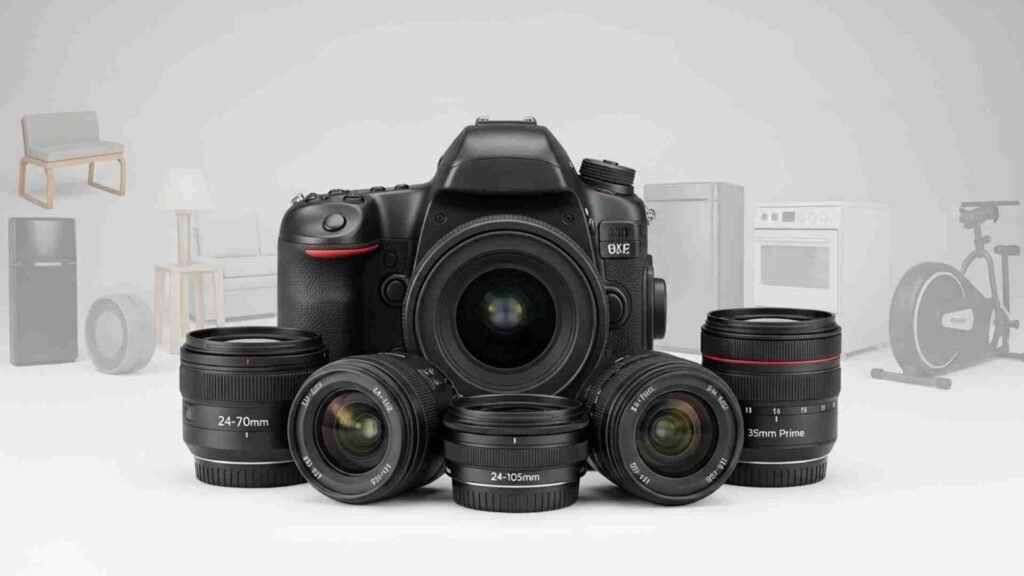
Choosing the Best Lens for Large Product Photography really depends on your studio size, the type of products you photograph, and the style of images your brand or clients prefer. However, if we narrow it down to the most reliable, versatile, and distortion-free choices, the clear winners are:
These lenses work for nearly every type of large product, from furniture and appliances to décor, machinery, and oversized fitness gear. They provide sharpness, accurate colour, minimal distortion, and excellent framing flexibility.
Whether you’re a professional product photographer or a brand building your eCommerce catalogue, investing in the Best Lens for Large Product Photography ensures your images look clean, consistent, and market-ready.
At the end of the day, even if you shoot with the Best Lens for Large Product Photography, your images still need high-quality editing to look perfect for eCommerce platforms, catalogues, marketplaces, and advertisements. That’s where Aitinsider comes in.
At Aitinsider, we provide professional image editing services for product photographers, online stores, and brands that want clean, polished, conversion-ready photos. Whether you’re shooting furniture, home appliances, bulky tools, or large commercial products, our editors can help with:
Our goal is to help your photos look high-end, consistent, and ready to impress customers, every single time. When you combine the Best Lens for Large Product Photography with Aitinsider’s editing expertise, your product images reach a professional level that stands out in any marketplace.
If you want clean, crisp, and beautifully edited photos for your brand, simply reach out to Aitinsider, your trusted partner in product image perfection.