
If you’ve ever tried taking product photos and felt confused about which f-stop gives you the sharpest, cleanest, and most professional-looking result, you’re not alone. Choosing the Best Aperture for Product Photography can feel complicated, especially when you’re shooting different types of products for eCommerce or catalog use. But once you understand how aperture affects sharpness, depth of field, and detail, everything gets easier. In this guide, I’ll walk you through how aperture works, what f-stop numbers really mean, and how to choose the Best Aperture for Product Photography depending on your shoot.
This guide is designed to be super simple, friendly, and practical-like a personal conversation. Whether you’re handling photos for Amazon, Shopify, Etsy, a personal portfolio, or a professional studio, this article will help you make better decisions. And because this topic has commercial intent, I’ll also help you compare aperture choices the same way you evaluate lighting, lenses, or product photography tools before buying or upgrading gear.
When we talk about the Best Aperture for Product Photography, we are really talking about one thing: controlling how much of your product stays in focus. Aperture controls depth of field-how much background blur you have, how sharp the edges are, and how crisp the product details look.
Aperture is written as an f-number: f/2.8, f/4, f/5.6, f/8, f/11, f/16, and so on. Smaller numbers like f/2.8 mean the lens opens wide and produces a shallow depth of field. Bigger numbers like f/11 mean the lens opening becomes narrower and produces a deeper depth of field.
Most product photography requires sharpness from front to back, because brands want the customer to see every detail of the product. That’s why the Best Aperture for Product Photography is usually somewhere between f/8 and f/11. These values give you the sweet spot where your lens performs best, producing sharp, accurate, clean images.
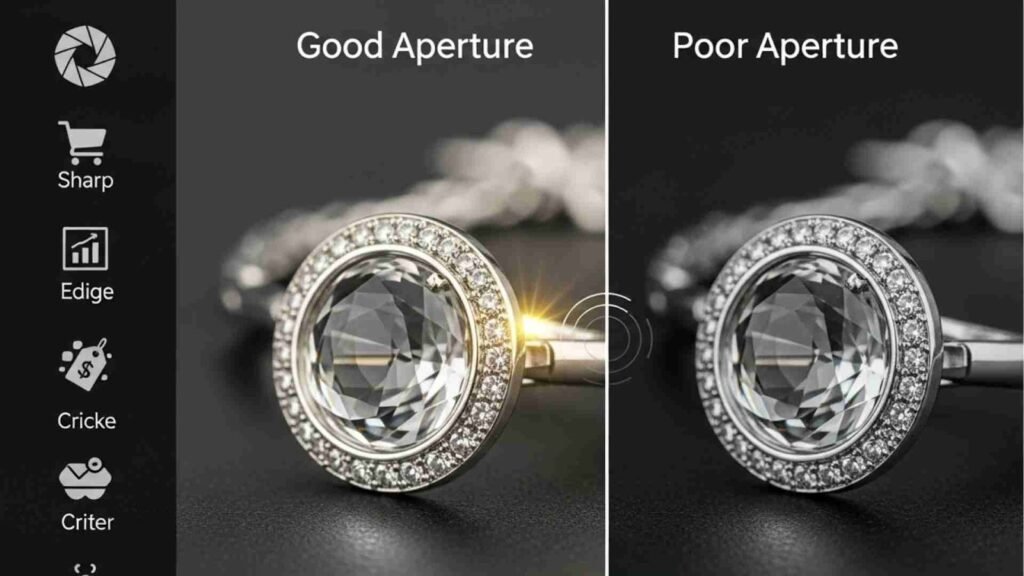
When customers shop online, they don’t get to touch or feel the item. Your images replace that real-world experience. So the Best Aperture for Product Photography must help you deliver clarity.
You want sharp edges, visible textures, and an overall photo that looks trustworthy. A poorly chosen aperture leads to soft edges, inconsistent focus, or blurry textures. That can make a product look cheap or unclear, which directly affects conversions.
In eCommerce platforms like Amazon, Walmart, eBay, and Etsy, the quality of your product photo can determine whether a customer clicks or scrolls away. A better aperture means better focus, better detail, and ultimately better sales.
So when choosing the Best Aperture for Product Photography, you’re making a commercial decision that directly impacts how customers perceive your brand.
Let’s talk about the most important point in this guide: The Best Aperture for Product Photography for eCommerce and catalog work tends to be between f/8 and f/11.
This range is considered the optical “sweet spot” on most lenses. Lenses are designed to be sharpest when slightly stopped down, not too wide, not too narrow.
At f/8, you get excellent clarity and detail without risking diffraction (softening due to too small an aperture). At f/11, you get a deeper depth of field, which is great for thicker or larger products.
Most professional product photographers rely on these two apertures for 80% of their shoots because the results are consistent and predictable. If you only remember one thing from this article, it should be this: the Best Aperture for Product Photography in most situations is f/8 or f/11.
Sometimes, you might want to use a wider aperture for creative reasons. While it’s not the typical choice for standard catalog shots, there are times when wider apertures are helpful.
For example, if you’re shooting lifestyle product images where you want the background to blur beautifully, f/2.8 or f/4 can help isolate the subject. This works well in soft branding shoots, social media content, and creative product scenes where depth of field adds emotion or drama.
But for pure eCommerce and catalog work, these wide apertures are not usually the Best Aperture for Product Photography because they make the edges or textures too soft.
Wider apertures should be used more for artistic value and less for accuracy or detail.
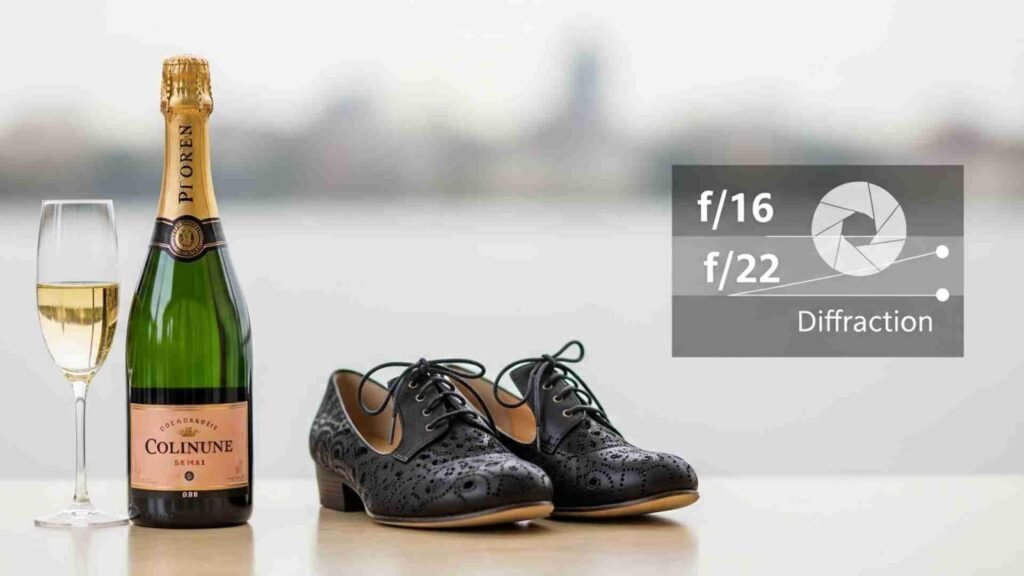
On the opposite end of the spectrum, you have small apertures like f/16 or f/22. These apertures give extremely deep depth of field, which sounds amazing-but there’s a downside: diffraction.
Diffraction happens when the aperture becomes too small, and light bends in a way that reduces sharpness. You end up getting more depth in theory, but your images look slightly softer overall.
This is why professional photographers rarely go beyond f/16 unless they absolutely must. If you are photographing something very tall, such as a champagne bottle, a pair of shoes, or a product with multiple layers, f/16 might help. But f/22 usually softens the image too much.
This is why f/8 to f/11 remains the Best Aperture for Product Photography for both sharpness and depth.
Different products behave differently in front of the camera. For example, jewelry needs extreme detail. Clothing needs texture. Electronics need clean lines. Cosmetics need color accuracy. Understanding product behavior helps you choose the Best Aperture for Product Photography in each situation.
Jewelry photography demands precision. You want the gemstones, edges, and metal texture to be perfectly visible. For this reason, most jewelry photographers shoot around f/11 or even f/13. It gives you enough depth to capture the sparkle without blurring the edges.
Clothing needs texture, pattern clarity, and a flat appearance. For flat lays, f/8 is usually enough. For 3D items like shirts on a mannequin, f/11 is safer.
Lipsticks, foundations, skincare bottles, and compacts are usually small but shiny. These items look best around f/8 to avoid background distractions and maintain clean focus.
Shoes often have depth and shape. f/10 or f/11 works beautifully to get both the front and back edges sharp.
Phones, laptops, watches, and gadgets need perfect clarity. These items usually look best at f/8 because electronics have lots of straight edges and tiny details.
Understanding your product will always help you pick the Best Aperture for Product Photography with confidence.
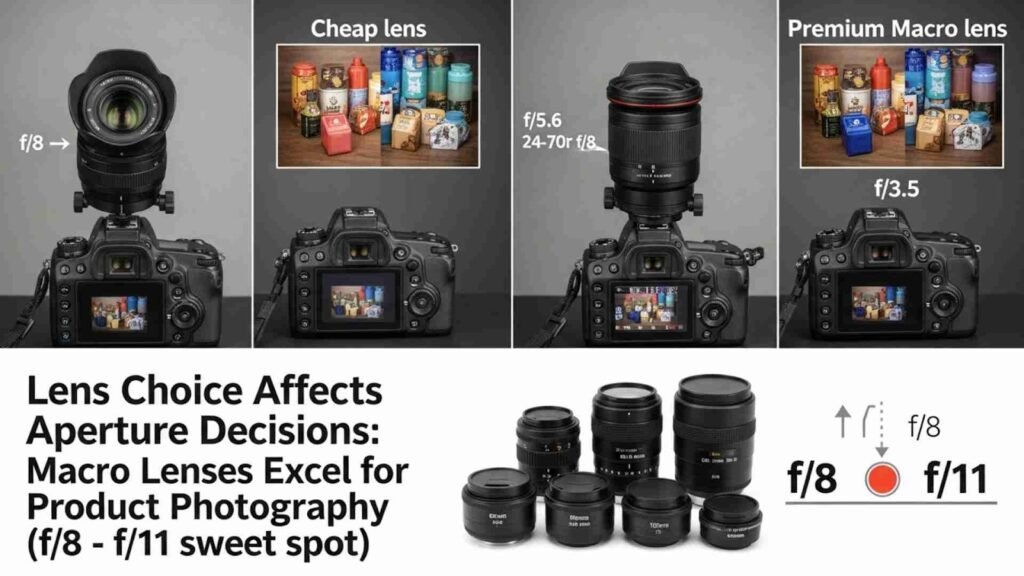
Your lens determines how your aperture behaves. A cheap lens might not be sharp at f/8, while a premium macro lens might be sharp even at f/3.5.
Most product photographers prefer macro lenses because they handle small details well and stay sharp at various apertures. A common choice is a 60mm, 90mm, 100mm, or 105mm macro lens.
With a good macro lens, f/8 or f/11 will almost always give you outstanding clarity. These lenses are designed for close-up sharpness, making them ideal for the Best Aperture for Product Photography.
If you use zoom lenses, be aware that they may be sharpest at slightly different apertures. For example, a 24–70mm lens might be sharpest at f/5.6 or f/8.
The point is this: every lens has its ideal range, but for product photography, the sweet spot almost always falls within the same general range-f/8 to f/11.
Even if you choose the Best Aperture for Product Photography, your results will suffer if your lighting is weak or inconsistent. Aperture and lighting work hand-in-hand. When you close your aperture to f/8 or f/11, less light enters the camera, so you need strong lighting sources to keep your exposure bright and clean.
This is why nearly all professional product photography studios rely on continuous LED panels, softboxes, parabolic lights, or strobes. A good lighting setup gives you the freedom to always use the Best Aperture for Product Photography without worrying about noise or underexposure.
In controlled studio environments, you can set your aperture for optimal clarity and let your lighting take care of brightness. This is one of the biggest advantages of professional product photography: consistency. Once you lock in your lighting and aperture, your workflow becomes incredibly dependable.
For eCommerce platforms, consistency is everything. Your images must match across the catalog so your brand looks professional. Choosing the right aperture and combining it with good lighting ensures that every product looks equally sharp, equally bright, and equally appealing.
Another reason photographers sometimes struggle with deciding the Best Aperture for Product Photography is that sensor size affects depth of field. Full-frame sensors produce shallower depth of field compared to APS-C or Micro Four-Thirds sensors at the same aperture. This means you may need slightly different f-stop settings depending on the camera you use.
If you’re using a full-frame camera, f/8 or f/11 usually works perfectly. On an APS-C camera, f/7.1 or f/8 will give you a similar depth of field to f/11 on a full-frame. Micro four-thirds cameras often produce a deeper depth of field, so you can stay around f/5.6 or f/8.
The important thing is to adjust according to your camera type. But regardless of sensor size, the sweet spot always lands close to the same range, reinforcing why the Best Aperture for Product Photography rarely changes dramatically between different camera systems.
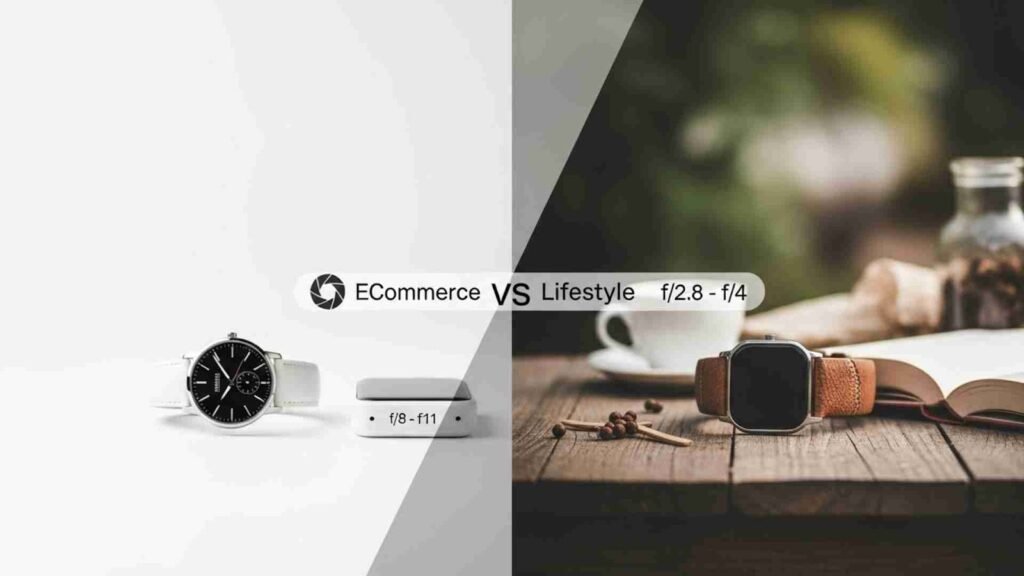
Product photographers often switch between two main types of images: clean white-background eCommerce shots and creative lifestyle shots. Each requires a different approach.
For pure eCommerce images with white backgrounds, clarity is everything. You want the entire product sharp from front to back, edge to edge. In this case, the Best Aperture for Product Photography is again f/8 to f/11.
But when shooting lifestyle content-such as laying out products on a table, using props, or shooting in a natural environment may want more artistic blur. Here, f/2.8 or f/4 adds depth, mood, and visual interest.
That’s why many brands shoot in two distinct styles. The eCommerce images sell the product by providing clarity and information. The lifestyle photos increase desire by showing the product in a mood or context. And aperture plays a huge role in shaping that emotional tone.
Sometimes, even the Best Aperture for Product Photography isn’t enough. Products with extreme depth-like watches, jewelry, macro shots, or tall cosmetics may still show blurred areas even at f/11. That’s where focus stacking comes in.
Focus stacking involves taking several photos with different focus points and blending them in software. The result is a perfectly sharp image from front to back, even when the depth of field is extremely shallow.
This technique allows you to use a sharper aperture like f/8 while still achieving total clarity. It’s especially useful for jewelry, detailed electronics, macro cosmetics, and technical items.
Professional studios often combine focus stacking with controlled lighting to produce flawless images. The combination ensures that every edge, surface, reflection, and texture is visible in the final photo.
Choosing the Best Aperture for Product Photography doesn’t guarantee perfect results if you’re unaware of common mistakes. Even small errors can cause blur or softness.
One of the biggest mistakes is shooting too wide, like f/1.8 or f/2.8, expecting professional bokeh. While this creates a dreamy look, it’s terrible for product photos where you need detail. Another mistake is shooting too narrow-like f/22-which causes diffraction and reduces sharpness.
Using a shaky tripod or accidentally bumping the setup also affects sharpness, even at the best aperture. That’s why professionals always use sturdy tripods, self-timers, or remote triggers to eliminate micro-shake.
Another mistake is inconsistent focus. For example, focusing on the background instead of the product’s front edge can ruin detail. Always focus on the most important part of the product-the brand logo, texture, gemstone, or key selling feature.
By avoiding these mistakes, your chosen aperture will deliver crisp, high-quality results every time.
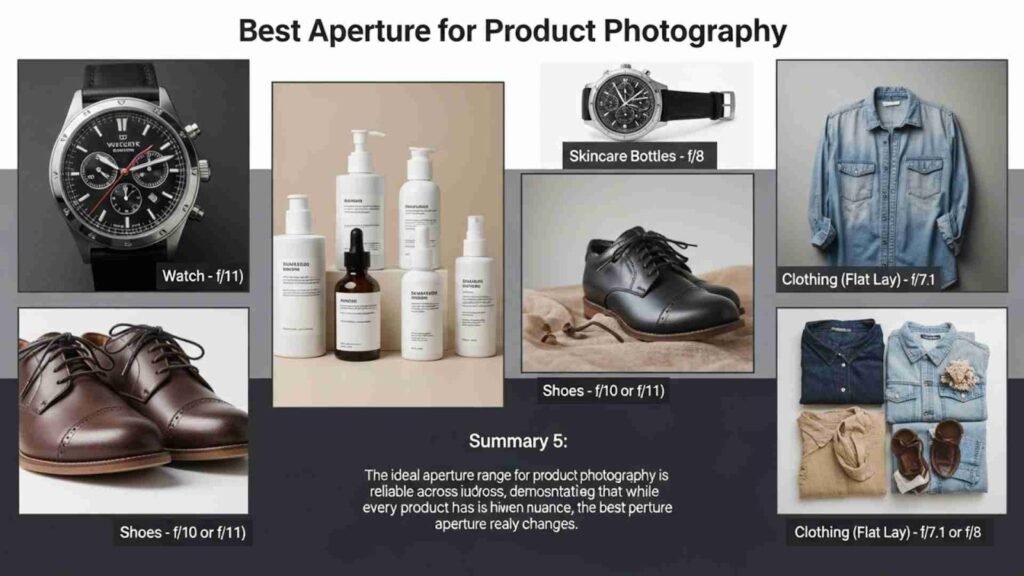
Let’s break down some real-world examples that help explain the Best Aperture for Product Photography more practically.
For a watch, the goal is to make the face, dial, numbers, and strap details sharp. Photographers often use f/11 because the watch has depth from the crystal surface to the strap. If shooting macro, they may focus stack to ensure perfection.
For skincare bottles, f/8 works beautifully because the shapes are usually simple and straight. The bottle edges become sharp, labels stay readable, and the colors remain accurate.
For shoes, photographers use f/10 or f/11 to keep the front toe shape, stitching, and heel area sharp.
For clothing, especially flat lays, f/7.1 or f/8 keeps the entire garment in focus while maintaining natural texture.
These examples show that while every product has its own nuance, the ideal range rarely changes. This is why the Best Aperture for Product Photography is so reliable across industries.
To simplify everything we’ve discussed, here are the most reliable choices:
For 90% of eCommerce photos:
• f/8 or f/11 – the universal sweet spot
For macro jewelry and extreme detail:
• f/11 or f/13 – deeper depth with minimal diffraction
For lifestyle product photos:
• f/2.8 to f/4 – artistic blur
For APS-C cameras:
• f/7.1 or f/8
For micro four-thirds cameras:
• f/5.6 to f/8
If you’re ever unsure, start at f/8. It’s the safest, cleanest, most reliable starting point for almost any product.
This is why the Best Aperture for Product Photography is consistently recommended across professional studios, online tutorials, and experienced photographers.
Choosing the Best Aperture for Product Photography matters more than most beginners realize. It affects sharpness, detail, focus, lighting, and ultimately how customers perceive your product. When you understand how aperture works and how it interacts with your camera, lighting, and product type, your images become more polished and professional.
For eCommerce and catalog shoots, sticking with f/8 to f/11 is the safest, most commercially effective choice. It delivers the clarity that customers trust and the consistency that brands demand.
If you want your product images to look truly high-end, focus on consistency, strong lighting, and choosing the right aperture for each situation. That combination is what separates average product photos from professional ones.
And if you need help making your product photos look perfect, clean, and polished, aitinsider is here to support you. We provide professional Image Editing Services that enhance clarity, remove imperfections, retouch reflections, clean backgrounds, and give your photos a premium finish.
Best Canon Macro Lens For Product Photography | 2026
[…] product photography usually uses deeper apertures like f/8 or f/11, good bokeh still matters for lifestyle or creative product […]